
Trauma-Informed Belonging
How can international schools cultivate belonging without asking students, families and staff to assimilate? Our study begins with listening: trauma-informed observation and voluntary conversations before any survey.
Designed by Nicole Bonnah and co-led with Janice Stewart-Yates. The study builds on Danau Tanu's research into third culture kids and the politics of belonging at international schools (Tanu, 2017).
Ten pathways to trauma-informed belonging
There is no single way in. Each pathway belongs to one of the five phases of the Anatomy of Trauma-Informed Belonging, developed by Nicole Bonnah, and colour shows which.
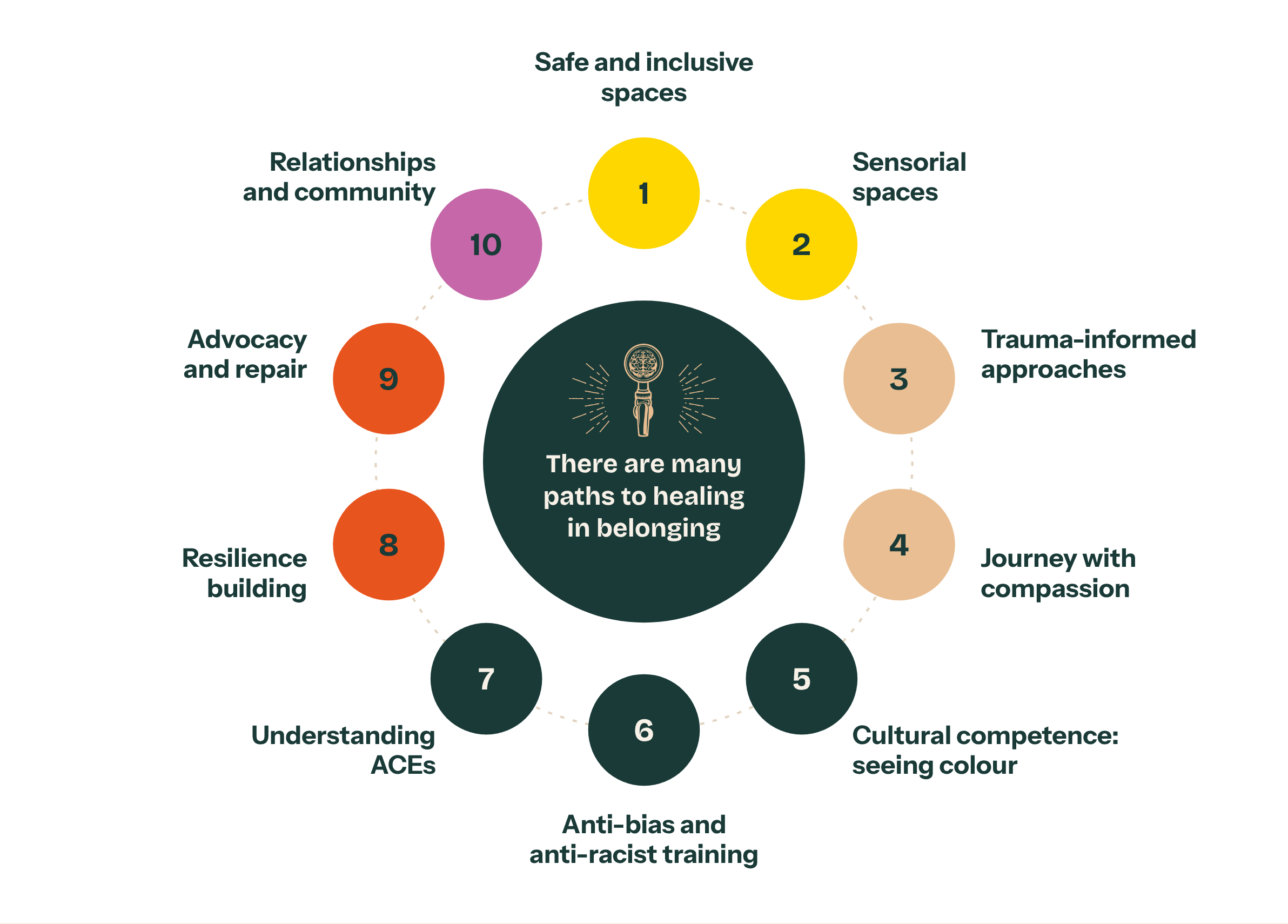
- Safe and inclusive spaces
- Sensorial spaces
- Trauma-informed approaches and practices
- Journey with compassion
- Cultural competence: seeing colour
- Anti-bias and anti-racist training
- Understanding ACEs
- Resilience building
- Advocacy and repair
- Relationships and community
What children carry into the classroom
Adverse childhood experiences (ACEs) are potentially traumatic events in childhood. The original CDC and Kaiser Permanente study linked them to long-term effects on health, learning and relationships (Felitti et al., 1998). Later research widened the lens to adversity that happens in communities, not only at home (Cronholm et al., 2015).
- Emotional, physical or sexual abuse
- Emotional or physical neglect
- Domestic violence in the home
- A household member with substance use or mental illness
- A household member in prison
- Parental separation or divorce
Felitti et al. (1998)
- Experiencing racism and discrimination
- Bullying
- Witnessing violence
- Living in an unsafe neighbourhood
- Living in foster care
Cronholm et al. (2015). Including these identified an additional 14% of participants exposed to adversity outside the home.
Much of the original ACE data came from white, middle-class, insured and educated participants. Racial trauma, including the everyday microaggressions children meet in classrooms and staffrooms, is still too rarely counted.
This is not only an American story
In a study of 1,904 adult third culture kids, 21% reported four or more ACEs and 35% reported three or more. The authors call for positive childhood experiences and trauma-informed practice across international communities, including schools.
Crossman and Wells, Caution and Hope (2022). The sample was not random, so it may not represent all TCKs.
Adults reporting four or more ACEs
When a child is in survival mode, the thinking brain goes quiet. What looks like defiance or shutting down is often a child saying: I am just trying to be safe.
That is why we connect before we correct, and why our work with schools starts with the room, the relationships and the nervous system (Souers and Hall, 2016; van der Kolk, 2014).
Belonging is protective
Adversity is not destiny. Adults who had more positive childhood experiences, such as feeling they belonged at school and had adults who cared about them, report better mental and relational health, even after adversity (Bethell et al., 2019).
At home, at school and in the community.
Who listen, notice and respond with patience.
Seeing yourself in the staff, the curriculum and the culture.
Naming feelings and needs, and recovering after loss.
Bring the study to your school
We work with leadership teams to listen first, then turn what we hear into policy and practice.
References: Bethell, C., et al. (2019). Positive childhood experiences and adult mental and relational health in a statewide sample. JAMA Pediatrics. Cronholm, P. F., et al. (2015). Adverse childhood experiences: Expanding the concept of adversity. American Journal of Preventive Medicine. Crossman, T., and Wells, L. (2022). Caution and hope. SIMRoots. Felitti, V. J., et al. (1998). American Journal of Preventive Medicine. Souers, K., and Hall, P. (2016). Fostering Resilient Learners. ASCD. van der Kolk, B. (2014). The Body Keeps the Score. Viking.